My 50 Years in Digital Arts
Marcus West, hosted by Sean Clark
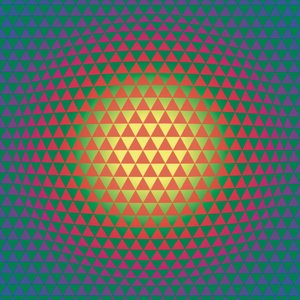 Title: My 50 Years in Digital Arts
Date: 17th September 2025
Speaker: Marcus West
Host: Sean Clark
Location: BCS Moorgate, London
Summary
Marcus West surveys five decades of digital art-making, from his first experiments with oscilloscopes and PDP-8 computers in the physics department at University College Cardiff in the 1970s to the intricate generative images he produces today. He explains how early analogue synthesisers and pen plotters opened up a world of geometric construction, and how a Fortran program could turn points and lines into mandala-like drawings and tessellated posters. After leaving academia, West returns to computer art inspired by a Bridget Riley retrospective, choosing to generate every pixel of a virtual canvas from first principles rather than capture the real world with a camera. He traces the evolution of several recurring series: recursive subdivisions of the rectangle, mandalas built from concentric elements, Fibonacci constructions governed by the golden angle and found in flowers and pine cones, rhombus illusions, and later Photoshop embellishments. Along the way he reflects on the precision and clarity of digital media, the spiritual quality of light glimpsed through layered forms, his playful one-off pieces such as Pythagorean fish, and proudly notes that three of his works now reside in the V&A collection. The talk blends technical detail, personal history, and an audience quiz.
Generated by AI using kimi-k2.7-code (2nd September 2026).