The Quantel Paintbox
Adrian Wilson, Kim Mannes-Abbott and Cesare Massarenti
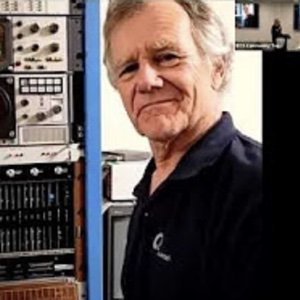 Title: The Quantel Paintbox
Date: 16th December 2023
Speaker: Adrian Wilson, Kim Mannes-Abbott and Cesare Massarenti
Summary
The Computer Arts Society's Christmas lecture celebrates the fortieth anniversary of the Quantel Paintbox, a revolutionary machine that transformed television graphics and wider creative practice during the 1980s. Adrian Wilson introduces the Paintbox's pressure-sensitive pen, real-time colour mixing and naturalistic line, explaining how its dedicated hardware and luminosity helped define a decade of broadcast, music video and advertising aesthetics. Bowtardi recalls the struggle artists faced in accessing these costly, union-controlled machines, describing how designers eventually displaced engineers at MTV and elsewhere, producing over-the-shoulder news graphics, show opens and interstitials around the clock. Matthias Paper traces a parallel path in Germany, where a childhood television demonstration leads to a Quantel training course, a Cologne newsroom and a still-active career making science-magazine graphics, now on a restored HAL system. The conversation returns repeatedly to preservation: Mark's restoration work, the rarity of surviving machines, the unique "fingerprint" of Paintbox output on CRT monitors, and plans to share Adrian's archive with the Science Museum. They discuss how the Paintbox anticipated Photoshop, democratised digital image manipulation, blurred the line between analog and digital techniques, and helped legitimise computer art as a mainstream visual medium.
Generated by AI using kimi-k2.7-code (3rd September 2026).