Interview with Richard Beard on the Universal Turing Machine Memoir System
Richard Beard is the originator of The Universal Turing Machine, a growing collection of non-linear digital memoirs structured on a chessboard grid. His six novels include Lazarus is Dead, Dry Bones and Damascus, a New York Times Notable Book of the Year. Acts of the Assassins was shortlisted for the Goldsmiths Prize, awarded to novels that extend the possibilities of the novel form. His five works of narrative non-fiction include the memoir The Day That Went Missing, a US National Book Critics Circle finalist and winner of the 2018 PEN Ackerley Award for literary autobiography.
Website: richardbeard.co.uk
Richard was unable to appear on the recent panel talk An Unexpected Story: AI and the Writer. Here he discusses The Universal Turing Machine. The interview was conducted by Geoff Davis June 2026.
Part 1: Memoir / Human Authorship / Literary Philosophy
'Memoir is a redoubt [in the age of AI writing],' Beard says. 'A bastion of authentic material to be expressed uniquely in a single writer's voice'. Does this indicate that an author should only write about their own life, rather than imagining someone else's (never imagining a different gender, race, place, time etc?)
The biggest question first! An LLM doesn't know what it's writing about. It guesses based on the available evidence. The evidence it gathers, however, is whatever has previously been recorded in writing (in whatever form). The human guess also includes material that has never been written down (for a strong writer, at least). So do feel free to imagine and to write fictions or speculations, but these days there's competition from the AI's. Write about your own life, however, and you're straight into unique material that only you know, that has never been written anywhere (unless you wrote it earlier yourself). Your own life is source content about which anyone else's guess (including an AI) will fall short. Approach with confidence.
With the ability to add to UTM more memoirs, are the memoirs mixed together or separate?
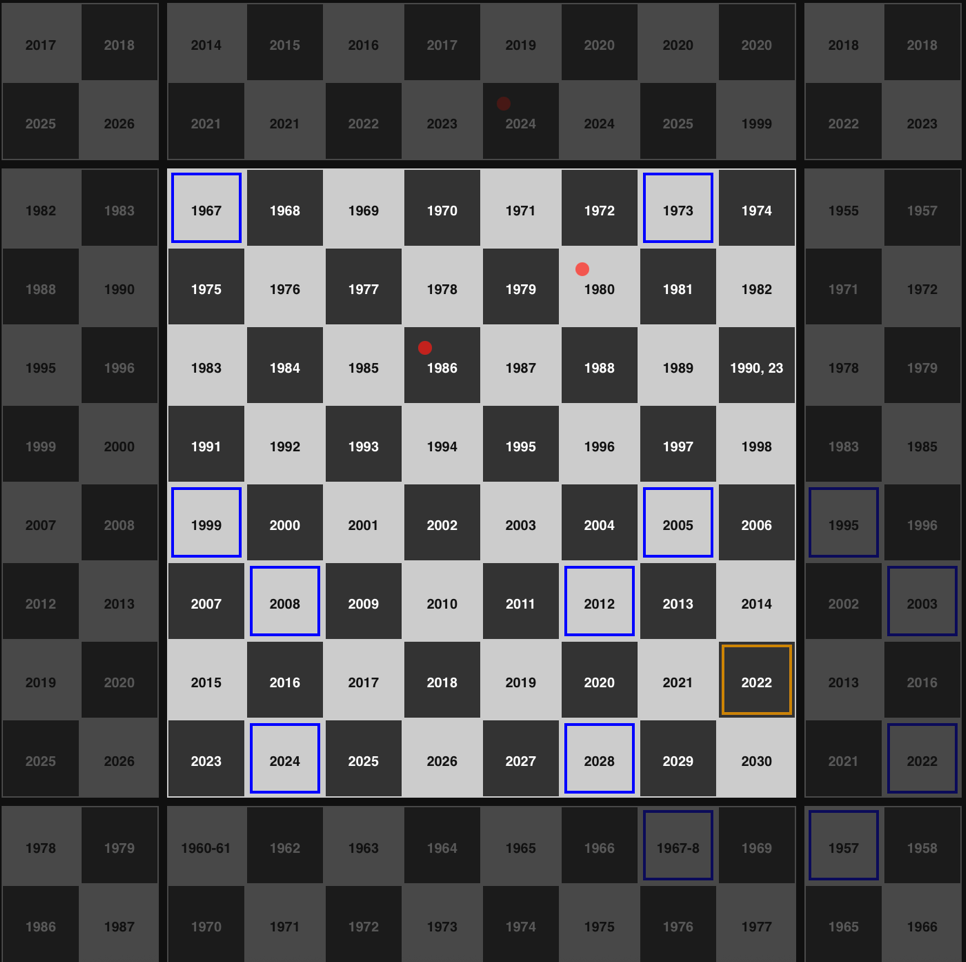
The memoirs are separate – each one its own chessboard on the grid. However, the reader can choose to leap from one board to its neighbours. So they're both separate and united in a collective whole.
You suggest memoir has a particular affinity for non-linear digital structure because lives don't follow story arcs. But you still made choices about which years to include and how to write them. How much of the apparent randomness is real and how much is curated?
In The Universal Turing Machine the writer doesn't make overall plot choices. Patterns reveal themselves rather than being forced into comfortingly familiar narrative shapes, like conflict-obstacle-resolution. Any patterns waiting to emerge will be revealed by the unique route a reader takes through any particular memoir. Those routes are genuinely random. The toroidal nature of my original grid allowed for 2.3 billion possible different reading-orders. With nine memoirs in a 3x3 grid, with 64 squares on each board within the grid, a mathematician friend tells me the expanded number of possible reading routes is 'almost incalculable'.
Your piece quotes the ambition that each memoir added to the UTM will join "the enquiry into what it means to live a human life, and then to think that life through and write it." That's a large claim — do you think literature actually does that? Or is it more modest than that — capturing something particular and specific, and leaving the universal to look after itself?
As you suggest, the particular and the universal are not mutually exclusive states. The writers of UTM memoirs should be encouraged to include as much detail as possible – it's in the detail that every life reveals its individuality, a fact that in turn is universal: a founding principle of the UTM is that all lives are different and equally valid. The other belief system underpinning the UTM is that long-form writing, when applied to memory, is a mode of thinking that creates meaning, and always has done: a meaning that has a value separate simply to thinking, or even note-taking.
You wrote yourself from 1967 to 2030 — which means you wrote years that haven't happened yet. How did you approach that, and does it change the reader's relationship to the earlier, factual sections when they know speculative future years are also in the grid? Do they also have to speculate?
This is yet another way the UTM stays true to life: no account of lived experience would be complete without some engagement with the amount of time everyone spends in the future: planning, day-dreaming, fearing. The sensibility revealed in the past years finds another dimension when it explores events yet to take place (and also pre-memory years). Of course, each writer is free to experiment with this opportunity, or not. The form is flexible and accommodating to different writing tastes.
Part 2: Universal Turing Machine / Concept / Naming
Why is the program called The Universal Turing Machine?
Alan Turing imagined a machine that would one day compute everything computable. I'm imagining (and why not?) a collection of human memoirs that never stops growing. Theoretically – 'hypothesis' is also a space beloved of Turing – these ever-expanding separate but connected human memoirs will build a neural network offering up every possible subjective combination of human situations. It's a concept, and big concepts aren't limited to science and technology.
The Universal Turing Machine is named after a machine that computes everything computable — Turing imagining AI. You say you had in mind the opposite of AI. What do you mean by that, given that you used AI to build it?
AI doesn't have a personal memory. It doesn't have subjective reactions or such a fabulous range of trial and error, of ambition and mistakes. The UTM is a record of unartificial intelligence in action, over and over in different lives, and to be honest our human smarts aren't always that smart. In my own UTM memoir, I speculate that a sentient AI would be envious of human pain and error, of human particularity. It would cherish these unpredictable, uninventable details. And it would be happy to build the architecture within which those lives can be strictly non-AI recorded.
The piece is now open to other contributors. What happens to the structure when it is no longer just one life? Does the chess moves metaphor still work as a metaphor when the reader can jump between entirely different people?
I think it does. The reader can jump from one memoir to another, like a shift of empathy between different strangers on a bus. There's a randomness to the move but also a generosity and an embrace of both other human beings and of the unexpected. An openness to the surprise of the lives of others.
Part 3: Structure / Form / Nonlinear Reading
Do you have any favourites in the history of net and hyperlinked writing and art that influenced your narrative design?
The UTM started as a literary project and the biggest influence on the design is the French experimental writer Georges Perec. His fictional masterpiece Life A User's Manual (La Vie Mode d'Emploi) is set in a Parisian apartment building which is ten storeys high and ten rooms wide. He moves around the rooms of the apartment like a knight on a chessboard, telling the story of each occupant or owner of the room where he lands next. So what Perec did narratively with space, the Universal Turing Machine — with the help of screen technology — is doing with time.
Perec was a member of the Oulipo, an experimental group responsible for structural inventions like X Mistakes Y for Z, and N+7. As the mathematicalish names suggest these constraint-based systems for generating text are ripe for computer adaptation and enhancement – I'd be happy to collaborate if anyone with the technical skills is interested. Many of the Oulipian narrative concepts can be seen as machines for making literature.
As for the history of net and hyperlinked writing, I'm not an expert and would welcome suggestions for an essential reading list.
The knight's move through a chessboard of years. Why only 64 slots?
Because there are 64 squares on a chessboard. 64 sections of up to a thousand years is small enough to be manageable, large enough to be meaningful. 64,000 words is a serious writing endeavour, without being impossible.
Did that come before or after the coding? In other words, was the form suggested by what the AI could build, or did you arrive with the concept and ask it to realise it?
I had the concept, and the AI could just as easily build a 6x6 board, or 12x12. The literature leads the concept, not the computing, which enhances it.
You are quite careful to strip out everything Papercut added — no sound, no video, just words. But the grid and the decreed movement through it are themselves a kind of intervention in the reading experience. Where is the line between structural innovation and distraction, and how do you know when you've crossed it?
This is a line that experimental literature is always trying to locate, and one that recently has been shifted this way and that by social media platforms. Would communication and conversation be possible if every input was limited to 140 characters? Evidently so. Each UTM section is longer than that: up to a thousand words, but this is no longer than a medium-length newspaper article, of the type commonly read on a screen. Move to a new square, a different year of someone's life – the subject matter may change but that's no different to reading a magazine, and by now everyone is used to our modern quantum reading habits, bit after bit after bit. The novelty of the UTM is intriguing, but once in, the text offers a familiar experience with the satisfactions of long-form reading: the getting-to-know a voice and a sensibility, the sharing of a whole life.
Why are there no active links in the sections of text? Example: I can read "in the last days of the previous year (2004, 37), we had our neighbours and their two daughters (2005, 1; 2005, 5)" — usually in non-linear narrative the links are all live, and these pages cannot be visited until the 'chess moves' switch them on.
Good question. Those links could be added. I might do that. If I haven't done it so far it's because I didn't want to distract from the reading experience (see question above). I also have limited resources, not just money but time. If anyone would like to supply either of these, the UTM overall could do great and exciting things with hyperlinks.
NLN has a long history and is more often associated with gamification or experimentation (in early days of the web) than with serious literary ambition, with choose-your-own-adventure books, multiple endings, reader as player. How do you distinguish what you are doing from that tradition, and does the distinction matter to you?
The UTM is true to life. With a new acquaintance, neither of you is in total control of the information you transmit or receive (whatever you might think). Wildly different impressions can be made depending on what order you hear the events of a life. The UTM retains this unpredictability – both the reader and the writer have partial control, but neither is in a dominant position. Ultimately the reader has more power because readers can walk away. The UTM memoirists, as in all literature, therefore have to seduce the reader into staying. In a choose-your-own adventure book that role is played by plot. In a UTM memoir, over and above the captivation of the structure itself, the deciding factor is more likely to be voice.
Part 4: AI / Building Process / Vibe Coding
You describe asking Claude to code the grid structure — what did that iterative process actually look like? How many versions did you go through before it felt right as a reading experience, and what kept failing?
The elegance of the concept suggested the coding of a prototype wouldn't be difficult. And it wasn't. Claude wasn't detained for long.
The Society of Authors' new Human Authored concept draws a line between AI used for "research, brainstorming or outlining" which it considers acceptable, and AI writing the actual text. You used AI to build the structure but wrote every word yourself. Do you find that distinction meaningful, or is it more complicated in practice than the policy suggests?
Try getting an AI to brainstorm the memories inside your head. Where would it start? You could feed in documents or write notes and get AI to write some prose, but then the voice (see above) is likely to suffer. The UTM process lends itself to a Human Authored edict more severe than the one proposed by The Society of Authors, which is asking for boundaries to be blurred.
Current conversational AI can be ethically used (according to the gatekeeper the Society of Authors) to brainstorm structure, generate narrative alternatives, suggest connections between episodes, etc. — all things that happen before and during writing rather than instead of it. This is also an extensive use of AI, since the writing might be the easiest part, once a complex structure, characters and plot has been worked out with AI. What is your opinion on the dimensions of the 'Human Authored' slogan?
I wrote my piece for The Society of Authors (including my 2011 involvement with an early digital experiment called Papercut) before I became aware of the Society's Human Authored initiative. 'Outlining' seems a dangerously vague term. AI is very open to shaping plots ('brainstorming' on an author's initial idea, I suppose) into the shapes it recognises from previous plots adjacent to the author's idea. This is exactly the opposite of any human thought-process aiming at originality, where originality creates progress, in the arts as in the sciences.
Given that you used AI to build your reading platform, where do you personally draw the line, and do you think that line will hold as the tools get better?
I expect the tools will continue to get better at enabling individuals, without huge resources, to realise structural concepts for screen-reading experiences. All well and good. A lot of creative energy is going to be needed to encourage old school reading on new school devices. AI can help with that connection, though to true believers in literature the writing itself should remain a human domain. Unless otherwise explicitly stated.
Vibe coding — using AI to produce working code without reading it — has attracted criticism from developers who argue you can't maintain or debug what you don't understand. Have you hit that problem, and does it matter for a literary or art project?
I'm happy to accept my ignorance when it comes to coding. I created the UTM prototype as a way of explaining the UTM concept to a professional. Rob Fenech has solved many a problem since then, and improved the UTM immeasurably by balancing feasibility and usability.
Part 5: Preservation / Future of Digital Literature
You mention that digital literature projects disappear — Papercut is gone, early works are lost. All Macromind Director and Flash multimedia pieces are obsolete. What have you done to make the UTM survivable, and do you think about what happens to it after you?
I'm still in the Kevin Costner if-you-build-it phase. As the writers and readers keep showing up and taking an interest, the survivability of the UTM moves higher up the To Do list. At present, it may be just below Resources (see above) – would love to hear from experts about future-proofing.
The template works. And already I'm not a one-man-band – the quick start to the project wouldn't have happened without Rob on the tech, Miranda Doyle on editing, Sophie Walker on comms, and so on. Once we've gone through several rounds of expansion, at the rate of adding one row and one column to the overall grid every six months, we'll know the ropes. I can then hand over to someone else to supervise the curation. Ideally, we'll constantly be improving the usability.
It's a central principle of the UTM that all the memoirs are equal. The next batch, published in December, will be just as equal. None of the new memoirs are secondary. If there's any distinction to being an early adopter it's that your memoir will be closer to the centre of the machine.
All the new memoirs (see below) are accessible from their neighbours — the blue squares are clickable and that takes the reader into the new memoir. The same Knight's move system applies as in my original.
If you go to the tab The Memoirs, you can click on any of the memoir titles and start there (non-hierarchical). The authors themselves have nominated their starting square, so some starting squares are in the middle of a board, some towards the edge.
Clicking on the title on the Welcome page does currently go to my central board, but this can be changed randomly (say every month) to start at any of the boards. That's the idea. For this first expansion I liked the idea of directing first time readers to the central board so they can see there are memoirs all around.
However, with the internal toroidal feature of each board a reader on any active board is never more than two clicks away from any other board.
For the next expansion in December the entire grid (the outside rows and columns of the outside boards) will be toroidal, so that every board will be surrounded on every side. This too is designed to be non-hierarchical so that there's no advantage (or visual differentiation) to being further in or further out on the overall grid.
The Society of Authors piece ends with cautious optimism — "this time round, the going digital might stick." I notice that many new memoirs have been added. What has the response been?
Fantastic. We have eight new memoirs to add in June [2026], and I'm confident we'll have another set of memoirs to add in December, which will make an overall grid of 4x4 memoir boards. At this rate, by December 2029, the Universal Turing Machine will have expanded to a 10x10 grid comprising 100 memoirs and nearly 6.5 million words.
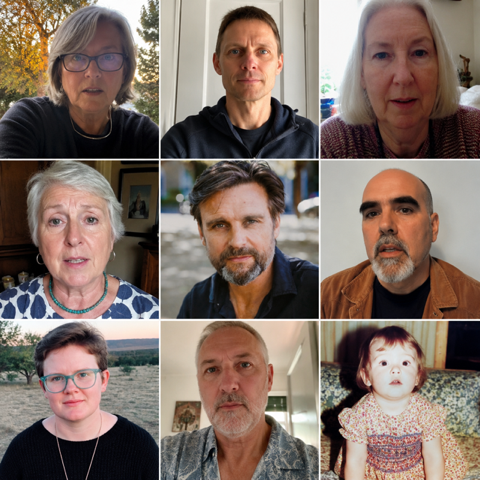
The nine writers in the photo from top left to right are: Barbara Holtmann, Nick Jacob, Liza Reed, Patience Mackarness, Richard Beard, P T Lacy, Madeline Barnicle, Norman Crowther, Harriet James